

Why No, My Son is Not Rain Man
I suppose it all started with Rain Man. Dustin Hoffman was just too awesome. America had never heard much about autism before he demonstrated his uber-genius to moviegoers, and we haven’t been able to forget it since. We learned that autism had an exciting side. It might be a sort mutation that grants mental superpowers. Sure, it comes with some baggage, but did you see what he did at the Black Jack table?
That was before the autism epidemic. Before the blue ribbons, the World Autism Day, the vaccination debate. We have “awareness” now. Among other things, we have learned that while many savants are autistic, most people with autism are not savants at all.
But the savant possibility still intrigues us, doesn’t it? The fact that a brain might be hyper-wired for math, music or science at the expense of social skills… that’s pretty cool. So cool, in fact, that we start to look for it even when it is clearly not there.
My son Jackson has autism. He is six years old and does not speak except to ask for his tortilla chips or his swimming trunks. Even then, his voice is barely comprehensible. He spends most of his time looking for twin objects–socks are his favorite–to flap wildly in front of his eyes. It looks odd, but it’s his way of shutting out all the stimulation that is rushing at him. He can’t take it all in, so he focuses on the flickering light created by his own rapid motion. Flapping, for him, creates a safe place.
Sometimes people see him flapping and say things like, “Hey, I bet he’s got an amazing rhythm! Is music his special talent?”
I force a smile and hold my tongue. No, my son is neither Rain Man nor Mozart. He is not a savant. Just a regular six year old with special needs.
I know they’re not trying to be insensitive. They are trying to help me look on the bright, exotic side. My son might not be able to talk to me, but he might have some wicked cool drumming skills!
There are other variations: “I bet Jack understands much more than we do.”
“I think he is laughing at us for being so dull.”
“I bet he sees angels when he squints like that!”
They all want him to have special powers–intellectual or spiritual–and part of me wants that, too. I want to glory in the achievement of my oldest son. I could post videos of him on Facebook. “Autistic drumming genius inspires crowd!” I could get hundreds of easy likes and feel validated as a father. It would make ME feel great.
But it would do nothing for Jackson.
The message my son needs to hear from me is simple: “I love you no matter what you can or cannot do. You are valuable just the way you are.” If I fail here, I fail as a father. Period.
This has been one of the most vital lessons I have learned this year: accept Jackson for who he is and embrace him where he is. I refuse to put false expectations on him for my own ego’s sake. I refuse to tell him his value is linked to his aptitude.
That means I must learn to enjoy my son’s sock-flapping without daydreaming about his rockstar potential. Yes, the boy has good rhythm, but I don’t smile because of that. Rather, I can smile because of the way he giggles while he is flapping. He clearly enjoys the sound of socks on a glass door, and that is enough for me.
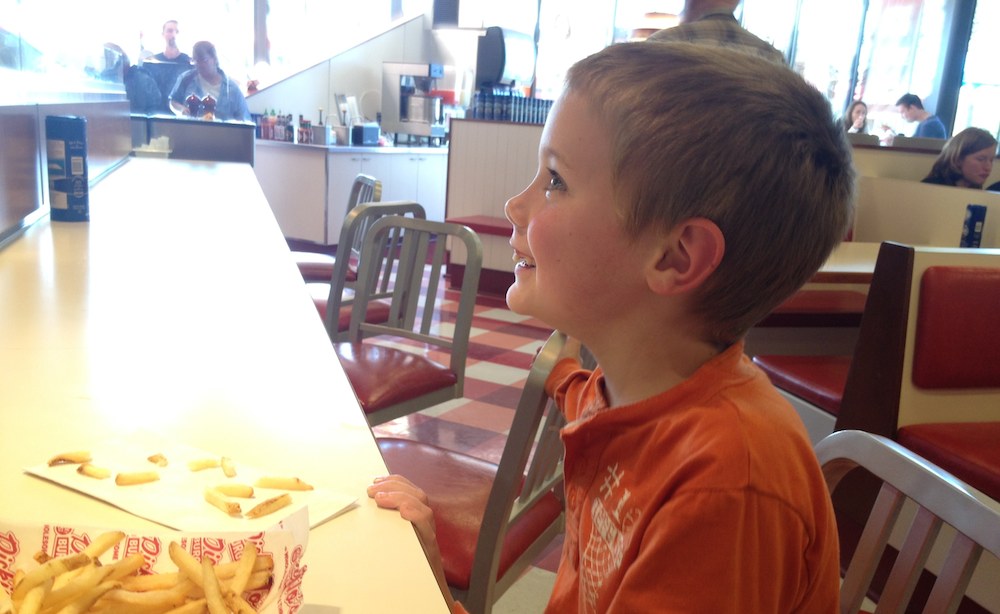
I look forward to discovering my son’s gifts in the future. But for now, his genius is in his laughter.






Very well said, Jason, I look forward to sharing this with my friend Jeff, who’s own son is about Jackson’s age and has autism. Thanks for sharing this.
I have tears…of pure joy right now!! What a beautiful way to share a bit about autism with others. I’m plan to share this in the Garden next week. Jack is such a blessing and I am so thankful to be a part of his life. What an extraordinary family he was given!!
Very cool Jason I admire you and Sarah and your journey through this. Jackson is such a sweet little boy.
You are making me cry. ALL parents should (but often do not ever) arrive at this best place of love. Real love, unconditional love. The way we are loved by our Father. I need to see this always and walk in it, always. Imagining (though it is reality) that my Father smiles just to see me do some small thing…Thank you, Jason.
Thank you guys!
And Lori, give our love the ladies at the Garden. I can hardly imagine what Jack’s life would be like without the things you all built into him, and everything you taught us. I wish that all parents of autistic children could experience what we experienced for those two years. And we are thrilled that you, Lori, continue to play a big part in this story.
As a parent with an Asperger child, I really appreciate what you have said. SO TRUE!
Thanks for sharing this.
Thanks, Daisy. As others have pointed out, all parents have to learn this lesson, but I think it’s especially crucial for those of us who have kids on the spectrum. How old is your child?
He is 18, but only recently diagnosed. As parents, we knew something was “different” but not what. We feel bad that we didn’t know sooner to take advantage of the tools available, but we are working to build a set with him. There were many things we did intuitively to help him cope, but there are other tools we can both learn. We have heard the savant possibility comments already, but know that God made him with his own set of unique characteristics. He probably won’t “change the world” but he has been a great son and like you said, “I refuse to tell him his value is linked to his aptitude.”
I shared your message on my facebook, and there have been several shares off of there. One family who appreciated your message has been an inspiration to us with their 9 year old daughter with High-Functioning Autism.
Thanks again.
Many blessings to you. Please try to find the recent report on using iPads with autistic children. Many have learned to communicate with their parents and therapists. It was on 60 Minutes July 15 th. Leslie Stahl was the reporter. For some reason, the children were able to focus on the iPad where they couldn’t focus on a live teacher.
Yes, Pamela, that is true! We bought one for Jackson last year and he has learned all of his letters and numbers with it. Autistic kids are extremely visual. It’s quite fascinating!
“I look forward to discovering my son’s gifts in the future. But for now, his genius is in his laughter.”
Beautiful words and sentiment! I miss you Hagues!
~Amanda (Runion)
Beautifully written Jay! We love you all lots and look forward to seeing you this fall!
Awesome. My autistic 5 year old son has one talent he’s superb at: laughing. He’s the happiest child I’ve ever met. I am very fortunate because it sees his autism is not severe. He’s verbal, affectionate and very, very easy going. Nothing bothers him. Well, maybe his twin sister sometimes.